

A snapshot you can prove is current.
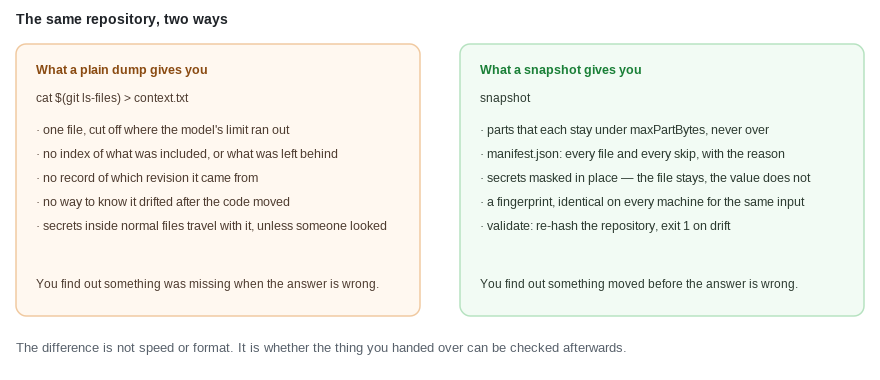
Plain-text parts under a hard byte budget, an index of every file and every skipped
file with the reason, and a validate command that fails when the code moves.


npx codebase-snapshot generate  # no install: straight to the snapshot
snapshot                        # once installed: detects the project, sets it up, generates
That writes ./snapshot/ — a directory you can drop into a chat, a prompt, a RAG pipeline or a
repository review. TypeScript and JavaScript first, but also Python, Go, Rust, Java/Kotlin,
C#/.NET, PHP, Ruby, C/C++, Vue, Svelte and Astro, without configuration.
Install · Quick start · Trust · AI agents · Docs · Site
Feeding a real repository to a model is awkward: files are too big, context windows are too small, and choosing what matters by hand neither scales nor repeats. This does it deterministically.
- A hard ceiling, not a target.
maxPartBytesis a limit, and nothing overflows it silently: a file too big for a part becomes a head/tail excerpt with an omission marker, andmanifest.jsonrecords it inincomplete[]with the line ranges it lost. - An index, not just text.
manifest.jsonlists every included file with its layer, kind, language, part, hash and a structural summary, every excluded file with the reason, and anincomplete[]list of every file it could only emit in part, with the line ranges it lost. - Provably current.
validatere-hashes the repository against the snapshot and exits non-zero on any drift, so a pipeline can gate on the context being fresh. - Repeatable. Two runs over unchanged input give byte-identical parts and the same
manifest.fingerprint; only the artifacts that carry a timestamp, run id or pid differ.
npm install -g codebase-snapshot      # puts `snapshot` on your PATH
npx codebase-snapshot generate        # or no install at all, one-off
npm install -D codebase-snapshot      # or add it to a project
codebase-snapshot is the canonical name to script against; snapshot is the short command a
global install provides, and from a project dependency the same binary is npx snapshot or the
npm run snapshot script init writes.
Requires Node.js 18+. Any npm client works — npm, yarn (classic and Berry with strict PnP), pnpm
and bun. Published from GitHub Actions with build
provenance, so npm audit signatures
verifies the tarball came from this repository at a tagged commit.
This is a 0.x release: the CLI surface may still change in a minor release until 1.0.0, so pin an exact version if you need a fixed surface today.
Type it. That is the whole first run.
snapshotIt recognises the project and says what it keyed on — Detected nextjs / Because next.config.ts
— then offers the recommended setup in one keystroke, or a walk through every setting with each
question starting on its default. Either way it writes the config, adds the npm scripts and the
devDependency, installs with your package manager, and generates. A project that already has a
config just generates.
Nothing to press — CI, a container, an agent:
npx codebase-snapshot --autopilotA first run never guesses. With no terminal and no --autopilot it exits 2 and names the
three ways forward, because a snapshot built from settings nobody chose is a snapshot nobody can
check.
npx codebase-snapshot init --yes   # config + scripts + devDependency + .gitignore
npm install                        # the package, into node_modules
npm run snapshot                   # generate
npm run snapshot:validate          # exit 0 = current with disk
The fingerprint is printed in full — all 64 hex characters, never elided — and it is the same value
as manifest.fingerprint.
snapshot/
├── README.md                  human summary of this snapshot
├── PROMPT.md                  the instruction sheet to paste with it
├── manifest.json              machine index: files, parts, hashes, config, skips
├── parts/part-001.md …        the code, grouped and size-budgeted
└── reports/
    ├── project-tree.md        directory tree of included files
    ├── navigation.md          links between layers, kinds and parts
    └── audit.md               secrets, large files, parse diagnostics, git state
Every artifact can be turned off (--skip-artifacts, --only-artifacts, or the config).
→ Snapshot output and manifest schema
A snapshot is only useful if you can believe it, so the tool is explicit about what it does not contain.
- Nothing is dropped silently. Every excluded path is recorded in
manifest.skipped[]with a reason —binary,gitignore,sensitive-file,symlink,read-error,excludedand the rest — andexplain <path>answers the same question for any single file. - Counts describe what was emitted.
includedBytesandincludedLinesare measured from the block in the part, not from the file on disk. A file that is not valid UTF-8 is kept and labelledutf-8-lossyrather than vanishing as "binary". - Drift is checked, not assumed.
validatecompares every file's hash and a digest of the settings the snapshot was generated with, so a changed budget or secret pattern is drift rather than silence. - The output directory is the tool's. Each run is written to a scratch directory and swapped in
atomically, and it refuses to replace a directory it did not create —
--out-dir srccannot destroy source code. - The brief travels with the payload.
PROMPT.mdis a brief, not a packing slip: the job, the system map the manifest can prove (layers, load-bearing modules, entry points, indexed surfaces), the recent commit history as claims to verify rather than rediscover, the evidence bar, the coverage owed, and calibration examples. Then the apparatus — this run's parts, partial files with their missing line ranges, fingerprint, and the attachment arithmetic. The judgement half can come from your own file (brief) and the job frompromptTask. A prompt that names the wrong snapshot is a lie that reads as current, so it is an artifact with a recorded digest andvalidatefails when it is edited. - Credential files are excluded by default —
.env,*.pem,.npmrc,id_rsa,*.tfstateand more — and secret-shaped strings inside ordinary files are redacted by masking only the matched span, never the whole line.
25 presets, detected from the repository — each contributing layers, kinds, ecosystem ignore patterns and a recommended part budget.
| Next.js | Nuxt | SvelteKit | Remix |
| Astro | Angular | Solid | Vue + Vite |
| React + Vite | NestJS | Express / Fastify / Koa | Node library |
| Monorepo | Django | FastAPI / Flask | Python library |
| Go | Rust | Java / Spring | .NET |
| Laravel (PHP) | Rails (Ruby) | Terraform / Docker infra | Docs-only |
| generic fallback |
Non-TypeScript languages get import/export/class/function summaries rather than being treated as
opaque text, and every summary is labelled ast, structural or heuristic so you know how much
to trust it.
→ Preset table and detection rules
| Command | Does |
|---|---|
| (none) | The guided first run. Asks once when the project has no config; generates otherwise. |
generate (default) |
Write the snapshot. --autopilot sets the project up first, unasked. |
setup |
Config, npm scripts, devDependency, install and generate, in one command. |
validate / check |
Compare the snapshot with the repository; exit 1 on drift. |
report |
Snapshot health, layer metrics, secret audit. |
init |
Interactive (or --yes) setup that writes a self-documenting config. |
explain <path> |
Why one path is included, which part it lands in, or why it was skipped. |
diff <a> <b> |
Compare two snapshots. |
describe |
The machine-readable contract (--format json). |
update |
Ask npm whether a newer release exists; exit 1 if it does. |
skill |
Print or install the agent skill. |
mcp |
Serve the repository to an MCP client over stdio. |
Exit codes: 0 success · 1 drift, refused generation, or nothing to snapshot · 2 usage error,
or a first run with no terminal and no --autopilot.
Once a day it checks the npm registry for a newer release and mentions it on stderr — skipped in CI,
in any --format json run, and in mcp. Turn it off with --no-update-check.
Everything an agent needs is available as data, and the tool can install its own skill.
npx codebase-snapshot describe --format json   # contract: workflow, options, exit codes
npx codebase-snapshot skill --install          # into .claude/skills + .cursor/rules
npx -y codebase-snapshot@0.20.13 mcp             # or serve it over MCP
An agent told only "use npx codebase-snapshot" can read the contract, follow its ordered
workflow, and produce a validated snapshot unaided — that path is covered by a test.
The MCP server exposes 26 tools — status, health, budget, history, tests, workspace, entrypoints, neighbors, routes, cycles, search, stats, review, diff_context, symbol, context, query, plan_for, answer, plan, generate, validate, locate, dependents, read and explain — plus
snapshot:// resources and seven prompts. Its reads come from the snapshot rather than the working
tree, so an excluded file stays excluded and a redacted value stays redacted, and
snapshot_validate answers the question an agent otherwise cannot ask: is the context I was given
still true?
It speaks both protocol eras, including the 2026-07-28 revision: stateless server/discover,
required MCP-Protocol-Version/Mcp-Method/Mcp-Name HTTP headers, cache hints on every
cacheable result, and the modern resource-not-found code. The suite drives it through the official
MCP v2 client over both modern stdio and modern HTTP.
→ Using this with an AI agent · MCP server · AGENTS.md · llms.txt
snapshot.config.json is written by init with every setting at its current value, so it
doubles as the reference. Deleting any line is safe: the defaults are real. JSON is deliberate:
the MCP server and serve refuse executable repository configs.
{
  "maxPartBytes": "120k",
  "excludePatterns": ["vendor/**", "**/*.min.js"],
  "artifacts": { "monolith": false },
  "budgets": { "default": "120k", "byLayer": { "docs": 40000 } },
  "includeSensitiveFiles": false
}import { generateSnapshot, resolveConfig, validateSnapshot, loadConfigFile } from "codebase-snapshot";
// Pass the repository explicitly: loadConfigFile returns only the config it found, so a
// directory with no config file would leave resolveConfig scanning process.cwd() instead.
const dir = "/path/to/repo";
const config = resolveConfig(await loadConfigFile(dir), { cwd: dir });
const manifest = generateSnapshot(config);
const validation = validateSnapshot(config);CommonJS works too (require("codebase-snapshot")), with type definitions for both. The CLI, the
API and the MCP server share one implementation, so anything one of them does is available in the
others.
| Installation | Every client, version pinning, agent skill install |
| CLI reference | Commands, options, exit codes, examples |
| Configuration | Every setting, all 25 presets, budgets, hooks, secrets |
| Snapshot output | Directory layout and the full manifest schema |
| Health audit | Leak, integrity and token audit of a generated snapshot |
| In the browser | serve: a local page to generate, preview and download a snapshot |
| Remote repositories | --remote: a shallow, SSRF-safe clone with recorded provenance |
| Delta packs | --delta: only what changed since a base snapshot, with its importers |
| Task slices | --slice: only what the planner picks for a question, at a token budget |
| Signed snapshots | --sign: an Ed25519 signature over the manifest, verified by health |
| Benchmarks | Reproducible token and time numbers for the three modes |
| Security review | Threat model, controls, tests and residual risks |
| Deploy | Container, compose and systemd, with the token requirement |
| Migrating | What changed from 0.12.14 to 0.20.13, and the behaviour changes that matter |
| Workspaces | --workspace: one snapshot per member, plus the index |
| Token budget | --budget-tokens: whole files chosen to fit a limit, not torn to fit a part |
| The brief | The half of PROMPT.md only you can write, and what is refused |
| AI agents | The contract, the skill, what an agent should avoid |
| MCP server | 26 tools, resources, both protocol eras, modern HTTP conformance |
| Troubleshooting | Every message and what to do about it |
| Changelog | Release history and breaking changes |
Guides: feeding a codebase to ChatGPT, Claude or Cursor · stale LLM context is a bug · how many tokens a codebase is · budgeting a context window · vs repomix · vs gitingest · vs code2prompt
Issues and pull requests are welcome — see CONTRIBUTING.md and the code of conduct. Security reports: SECURITY.md.
MIT © Ankur Halder
Built by Ankur Halder · documentation · npm