






I'm a 3rd-year Software Engineering student (full scholarship, GPA 3.78/4.00) who is fascinated by every corner of AI. My long-term goal is to become an AI researcher / scientist: to do a PhD in AI in the USA and help shape where the field goes next.
I care about both halves of the job:
- 🔬 The science: ML/DL theory, the math underneath, reading papers and re-implementing them until I really understand them.
- 🛠️ The engineering: training models, serving them, tracking and deploying them, and turning them into real products.
"If I can't build it from scratch, I don't understand it yet." 🧩
class BartuOnder:
    role      = "AI/ML Engineer  →  AI Researcher"
    focus     = ["Deep Learning (PyTorch)", "LLMs & Transformers", "RAG & Agentic AI", "MLOps"]
    building  = "end-to-end, scalable, AI-powered SaaS products"
    next_step = "PhD in AI 🇺🇸"

    def philosophy(self):
        return "Read the paper. Implement it. Break it. Ship it."
⭐ Flagship Project: AxiomForge
Replicate machine-learning claims with statistics, not with a language model. 🔬
An autonomous AI research agent that reads a claim (or an arXiv link), tests it on many real datasets inside a sandbox, and lets Python, not the LLM, decide the verdict. The research agent then proposes its own follow-up hypotheses and tests them on datasets it has never seen.
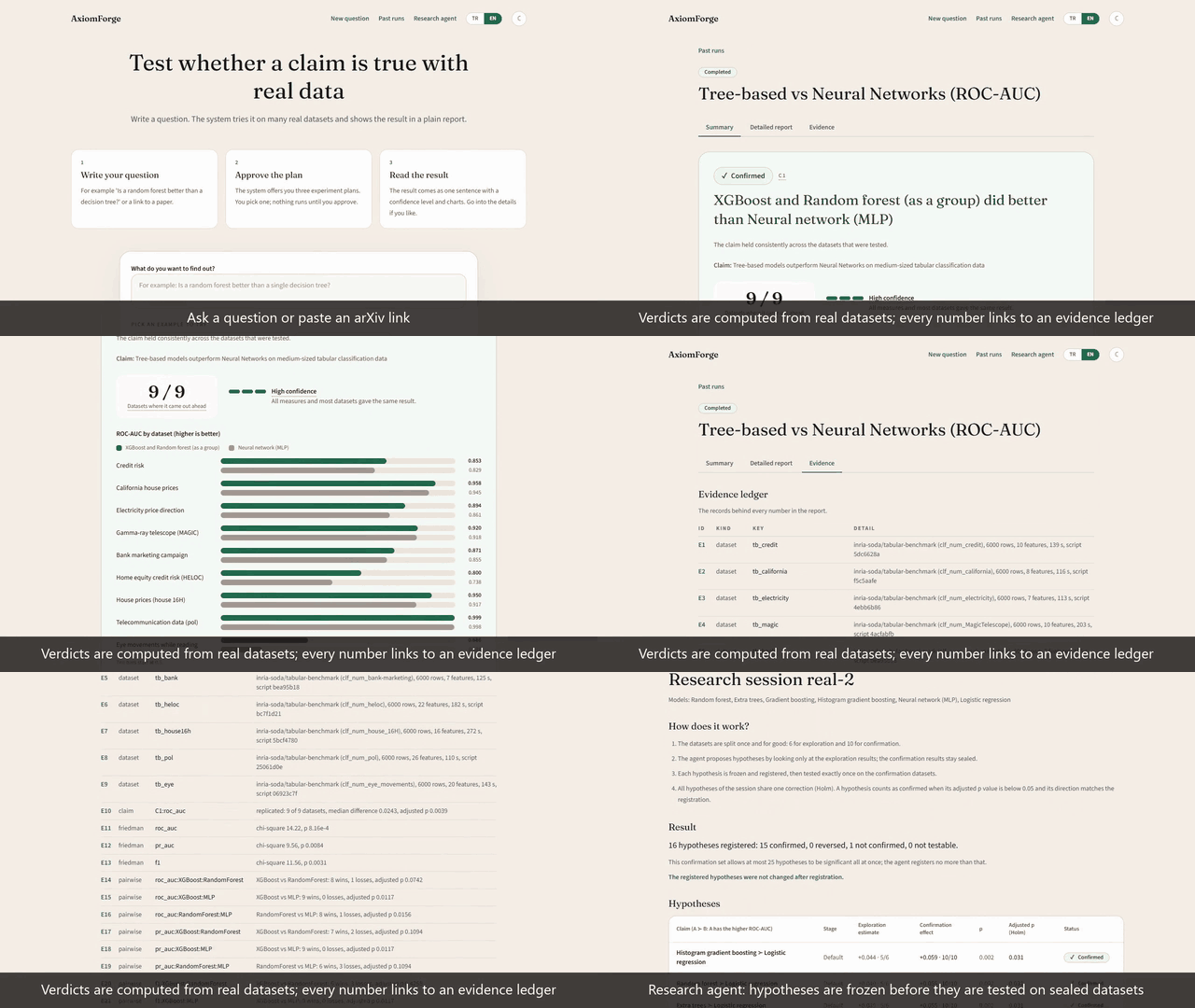
70-second walkthrough recorded from the real console.
💡 The idea: LLM agents write fluent conclusions but are unreliable judges of evidence. AxiomForge splits the work: the model plans experiments and writes prose, while a deterministic statistics layer computes every verdict and ties every number to an evidence ledger.
| 🧪 Question | 📊 Measured result |
|---|---|
| Does it get known claims right? | 10 / 10 established comparisons judged as expected, on 9 real datasets |
| Does it invent differences? | Decisive verdict in only 2.1 % of simulated worlds with no true effect; 0 / 45 real-model comparisons significant when the only difference was the random seed |
| Does the research agent inflate discoveries? | Family-wise error 3 %, versus 24 % for an agent that selects and tests on the same data and 89 % for uncorrected testing |
| A real research session | 6 models × 16 datasets: 16 hypotheses registered → 15 confirmed, 0 reversed, 1 not confirmed. The "winner's curse" overestimated the lead of tree ensembles ~3× on the exploration data, so only confirmation datasets are reported |
🔑 What makes it interesting
- 🔒 Sealed confirmation data: the hypothesis generator never sees the confirmation datasets. Hypotheses are frozen with a SHA-256 digest before testing, and
python -m app.research verifydetects tampering. - 📐 Real statistics: Wilcoxon signed-rank, Friedman, Holm and Benjamini-Hochberg corrections, with the dataset (not the split) as the unit of replication.
- 🚧 LLM output is policed: the paper text is composed from ledger values and checked by 17 deterministic rules that reject overclaims.
- 📏 Honest limits: conservative, low power under 1 ROC-AUC point, and the real session reproduces a known finding (Grinsztajn et al., NeurIPS 2022) rather than claiming a new one.





Click a section to expand 👇
🔬 Research & Theory
Reading papers, deriving things by hand, and re-implementing architectures from scratch to see how they really work.


See 🧪 Research & From-Scratch Implementations below.
🧠 AI / ML / GenAI
| Area | Topics & tools |
|---|---|
| Deep Learning | PyTorch, CNNs, Vision Transformers (ViT), MobileNet, DeBERTa, transfer learning, mixed-precision training |
| NLP & LLMs | Hugging Face Transformers, fine-tuning, semantic search & embeddings, structured outputs |
| Computer Vision | OpenCV, image classification, object detection (YOLO), face recognition & emotion analysis |
| GenAI / RAG | RAG pipelines, vector databases (Chroma, Qdrant), chunking & retrieval evaluation (Hit@k, MRR) |
| Agentic AI | Tool calling, ReAct loops, planning, memory, reflection, LangChain / LangGraph (human-in-the-loop interrupts, checkpoints), autonomous research agents, LLM output guardrails |
| Evaluation & statistics | Wilcoxon, Friedman, Holm / Benjamini-Hochberg corrections, false-positive calibration, power simulations, experiment reproducibility |
| Data science | NumPy, SciPy, Pandas, Matplotlib, Seaborn, scikit-learn, XGBoost / LightGBM / CatBoost |
🚀 MLOps & Deployment
Models that only live in notebooks don't count. I train → track → containerize → serve → monitor.
- 📈 Experiment tracking: MLflow
- 🐳 Containers: Docker, Docker Compose
- ☁️ Cloud: AWS
- ⚡ Inference: async inference queues (Celery + RabbitMQ), ONNX Runtime, Redis caching
- 🧰 Sandboxed execution: running agent-generated experiment code in isolated sandboxes (E2B)
- ✅ CI & quality: GitHub Actions, Pytest, mutation checks, Playwright browser tests
- 🗄️ Model & artifact hosting: Hugging Face Hub

🏗️ Backend & SaaS Development
Production-minded backends that wrap AI models in clean, tested, scalable services.
| Layer | Stack |
|---|---|
| API | FastAPI, Starlette, Pydantic |
| Async & queues | Celery, RabbitMQ, Redis |
| Data | PostgreSQL (+ pgvector), SQLite, SQLAlchemy, Alembic, Redis, Vector DBs |
| Frontend | Next.js, Tailwind CSS (dashboards for my SaaS products) |
| Quality | Pytest, Clean Architecture, Dependency Injection |
🛡️ Security
I build AI products, so I also care about securing them.
- 🔐 Web & API security: OWASP Top 10, OWASP Top 10 for LLM Applications, API security
- 🔑 AuthN / AuthZ: OAuth, JWT, API keys
- 🚦 Hardening: rate limiting, reverse proxy, basic pentesting
- 🧱 AI security: prompt-injection defense, PII redaction (Sentinel-Shield)
💻 Languages & Tools
Learning by building: no black boxes, paper-faithful code, and tests where it matters.
|
Paper-to-code implementation of the original 2017 Transformer, written to match the paper (Post-LN, sinusoidal PE, tied embeddings, label smoothing, Adam warmup, beam search with length penalty) rather than wrapping  
|
Clean from-scratch GPT-2 small: masked multi-head self-attention, FlashAttention via SDPA, loading of official pretrained weights, bf16 mixed-precision fine-tuning with cosine LR, grad accumulation and clipping, and temperature / top-k sampling. 
|
|
Agents in pure Python, with no frameworks: LLM call → tool calling → ReAct agent loop → memory → plan-and-execute → reflection, plus evals and tests. The goal: show there's no magic in an agent, just a loop.  
|
Classic estimators in NumPy only: linear/logistic/softmax regression, decision trees, random forests, second-order gradient boosting, dual SVM (SMO), GMM, GDA, naive Bayes, k-means, PCA and a one-hidden-layer MLP. Every model is derived from an explicit objective.  
|
|
A small neural-network library with layers, activations, losses and manual backprop, validated with gradient checking and demos on XOR, regression and classification.  
|
A decoder-only GPT trained on Shakespeare's poetry to emulate the Bard's linguistic style and meter: dataset, model, training and generation scripts.
|
Also: 📚 Paper-to-Code (a growing home for AI/ML/DL paper implementations) · 🔥 PyTorch-General-Codes (CNNs, ViT, transfer learning, TensorBoard, YOLO) · 📊 Kaggle notebooks
End-to-end AI products, from model to deployment.
| Project | What it does | Stack |
|---|---|---|
| 📑 Veridex | Extractive contract risk QA SaaS. Fine-tuned DeBERTa-v3 on CUAD → 87.96 F1, tracked with MLflow. Inference isolated from the API via Celery/RabbitMQ, Redis caching, JWT/API-key auth, Next.js risk-card dashboard. 🤗 Model | PyTorch DeBERTa-v3 FastAPI Celery Redis PostgreSQL Next.js MLflow Docker |
| 🛡️ Sentinel-Shield | AI security firewall for LLM apps: PII redaction and prompt-injection blocking. Deployed on AWS, with JWT auth, Redis rate-limiting and a user dashboard with API keys and stats. | FastAPI Starlette SQLAlchemy AWS Redis Next.js |
| 🥗 MacroFit AI | Estimates calories and macros from food photos with a Vision Transformer, then builds nutrition tracking and workout plans. AI layer isolated via dependency injection. | PyTorch ViT FastAPI Next.js PostgreSQL Docker |
| 🖼️ Vision Classifier API | ViT image-classification platform with an async task queue so heavy inference never blocks the server. JWT-secured and horizontally scalable via Docker. | PyTorch Hugging Face Celery RabbitMQ JWT Docker |
| 🌿 LeafLens | MobileNetV3 detecting 38 plant diseases at ~97% accuracy, served as a REST API with request logging. | PyTorch FastAPI SQLAlchemy Tailwind |
| 👁️ DeepGuard | AI access-control / mini-SOC: face recognition, age estimation and emotion-based anomaly detection (anger/fear) with real-time event logging. | PyTorch Transformers FastAPI |
| 🎮 NextQuest | LLM taste-based recommender for games, movies, books, series and anime, with Pydantic structured outputs, top-up rounds for incomplete answers and per-query taste snapshots. | LangChain OpenAI Pydantic PostgreSQL Docker |
| 🧠 DocuMind API | Production-grade RAG platform to chat with your documents: async ingestion, vector search, ONNX inference and MLOps tooling. | FastAPI PyTorch ONNX Qdrant Celery MLflow |
| ☣️ ToxGate | Async Turkish toxicity detection PoC: DistilBERT on ONNX Runtime behind FastAPI, Celery workers and a Redis result cache. | DistilBERT ONNX FastAPI RabbitMQ Redis |
🏢 Software Engineering Intern, GullsEye Logistics Technologies Inc. (20 days)
Designed and built, end to end, a fully offline AI-powered semantic search engine over enterprise documents.
- ⚡ Cut search latency to ~5 ms by optimizing vector matrices with NumPy
- 🎯 Reached Hit@3 = 90.6 % and MRR = 0.735 using custom chunking and an automated evaluation harness
- 🤗 Used Hugging Face MiniLM-L12 embeddings, with a CLI on top of the core engine
- ✅ Secured the whole project with 164 unit and integration tests (Pytest)

- 🔭 Re-implementing more landmark papers in Paper-to-Code
- 🌱 Going deeper into LLM fine-tuning, RAG evaluation and agentic systems (LangGraph)
- 🎓 Preparing for graduate studies / PhD in AI in the USA
- 🤝 Open to research collaborations, internships and interesting AI projects