

We build a tiny operating system from scratch, so anyone can read it, learn from it and make it their own.


Piux is a small, Unix-like operating system for 32-bit x86, written entirely in freestanding C and NASM. No Linux underneath, no borrowed kernel: every layer is ours, from the boot handoff to the desktop.
In practice, Piux is an OS you can boot in QEMU in a minute and then actually understand:
- 🖥️ It boots into a real desktop. PDE, our own desktop environment, runs in user mode on a 1280×720 framebuffer, with a launcher, taskbar, terminal and system info app.
- 💾 It has real storage. A read/write ext2 filesystem behind a Unix-like VFS, plus a first-boot installer and user accounts with hashed passwords.
- ⚙️ It runs real programs. ELF executables in ring 3, syscalls, isolated address spaces, a preemptive scheduler and
initas PID 1. - 🧩 It's modular. Core features like the VFS, the network stack and the installer are relocatable kernel modules loaded at boot.
- 🌐 It talks to the network. An RTL8139 driver and an IP stack (ARP, IPv4, ICMP, UDP, TCP) written from zero.
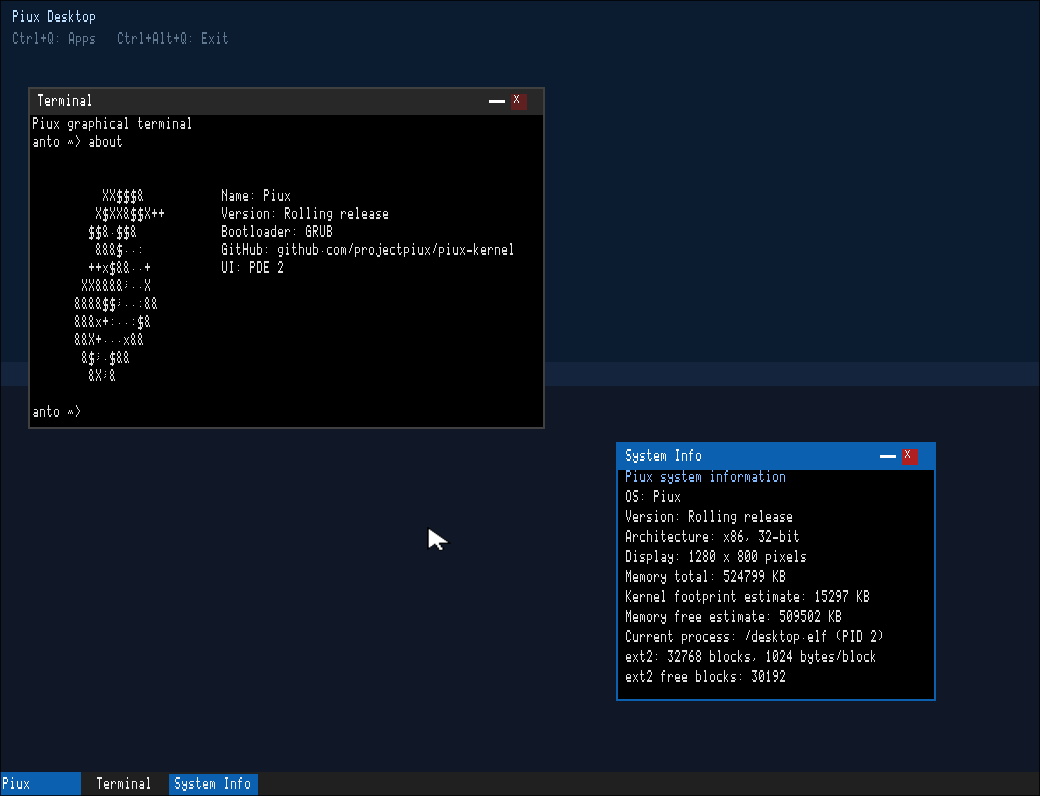
PDE running on Piux in QEMU.
https://github.com/projectpiux/piux-kernel
Note
Pix is under active development.
Pix is the package manager built into Piux. It runs on top of the OS's own network stack, so software can be downloaded over HTTP directly from inside Piux. It's written in C like everything else and evolves together with the system.
https://github.com/projectpiux/pix-pkgmanager
| 🚀 Try Piux | Clone piux-kernel and run bash fast-all.sh to build and boot it in QEMU |
| 📚 Read the code | The kernel, drivers, desktop and docs are all in the same repo, built to be explored |
| 🤝 Contribute | Fork, branch, open a Pull Request. See CONTRIBUTING.md |
| 💬 Talk to us | Join the community on Fluxer |
Warning
Piux is a learning-oriented project with an experimental security model. Use QEMU rather than real hardware.
Released under the GPLv3 • Built with C, NASM and curiosity